
Less Manual Data Entry.
AI helps capture and map existing product information from packaging, Excel files, artwork and other sources.

Faster Product Data for Retail and E-Commerce
Structured product data becomes available for review and distribution sooner.

Maintain Expert Control
Your team assesses exceptions, checks data quality and makes the final approval decisions.
Less Manual Data Entry
AI helps capture and map existing product information from packaging, Excel files, artwork and other sources.
Faster Product Data for Retail and E-Commerce
Structured product data becomes available for review and distribution sooner.
Maintain Expert Control
Your team assesses exceptions, checks data quality and makes the final approval decisions.
From Product Materials to Validated Product Data.
More Than OCR: Understanding and Mapping Product Information.
OCR recognises text in images and documents. BYRD b-managed AI Product Data Capture goes further: AI interprets whether a piece of information refers to a net quantity, an allergen or a marketing claim, for example.
It maps the information to the appropriate attributes in your data model, taking into account required formats, units and relationships between sources. Your team reviews and approves the results.

Provide Source Materials
Packshots, artwork PDFs, data sheets and spreadsheets provide the basis for data capture.

Capture and Map Information
Structured product data becomes available for review and distribution sooner.

Maintain Expert Control
Your team assesses exceptions, checks data quality and makes the final approval decisions.
From Product Materials to Validated Product Data.
More Than OCR: Understanding and Mapping Product Information.
OCR recognises text in images and documents. BYRD b-managed AI Product Data Capture goes further: AI interprets whether a piece of information refers to a net quantity, an allergen or a marketing claim, for example.It maps the information to the appropriate attributes in your data model, taking into account required formats, units and relationships between sources. Your team reviews and approves the results.
Provide Source Materials
Packshots, artwork PDFs, data sheets and spreadsheets provide the basis for data capture.
Capture and Map Information
Structured product data becomes available for review and distribution sooner.
Maintain Expert Control
Your team assesses exceptions, checks data quality and makes the final approval decisions.
It's Already on the Packaging. Now Bring It into Your Data Model.
The documented rice drink example shows how captured information is reviewed within the data model. Differences between newly captured and existing information can be compared and assessed by your team.
Mapping: Captured information is assigned to the correct attribute.
Quality Check: Inconsistencies become visible.
Decision: Your team decides whether to accept or reject a discrepancy.
It's Already on the Packaging. Now Bring It into Your Data Model.
The documented rice drink example shows how captured information is reviewed within the data model. Differences between newly captured and existing information can be compared and assessed by your team.

Mapping
Captured information is assigned to the correct attribute.

Quality Check
Inconsistencies become visible.

Decision
Your team decides whether to accept or reject a discrepancy.
»Our customers are already benefiting from more efficient processes and less manual effort.«

Where Can AI Support Your Product Data Capture?
Make Capturing Supplier Information Easier
Supplier-Onboarding
E-Commerce Content Capture
Product Data Migration
GDSN Data Capture
Regulatory Data Capture
Where Can AI Support Your Product Data Capture?
Make Capturing Supplier Information Easier
Supplier-Onboarding
E-Commerce Content Capture
Product Data Migration
GDSN Data Capture
Regulatory Data Capture

Discover What's Possible with AI-Powered Product Data Capture.
Managing multiple suppliers often means dealing with a wide variety of documents and file formats. BYRD b-managed AI Product Data Capture helps capture existing information from these materials and map it to your data model.This opens up new opportunities for supplier onboarding and collaboration through a supplier portal.

Part of an End-to-End Product Content Process
AI Product Data Capture enhances BYRD b-managed by supporting data capture and structuring. Data management, enrichment, quality assurance and approval follow as part of the process. For distribution via the GS1 GDSN, the BYRD b-synced data pool completes the workflow.
Discover What's Possible with AI-Powered Product Data Capture.
Our free Trend Guide, "The Future of Product Data Capture", uses practical examples to show how existing information can be transformed into structured, verifiable product data.
- How AI interprets information and maps it to your data model.
- How data capture, validation and expert approval work together.
- Which five use cases could be relevant to your business.
You are currently viewing a placeholder content from HubSpot. To access the actual content, click the button below. Please note that doing so will share data with third-party providers.
More Information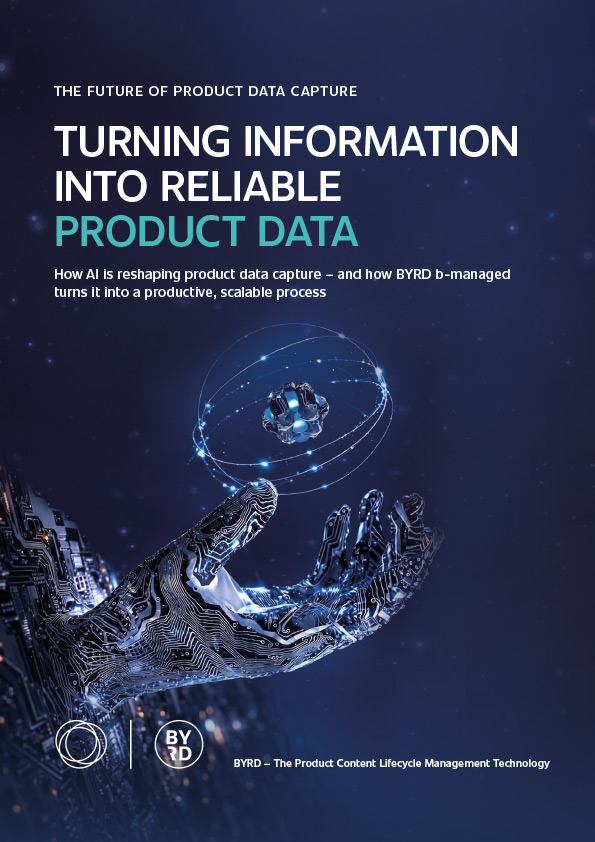
Discover What's Possible with AI-Powered Product Data Capture.
Our free Trend Guide, "The Future of Product Data Capture", uses practical examples to show how existing information can be transformed into structured, verifiable product data.
- How AI interprets information and maps it to your data model.
- How data capture, validation and expert approval work together.
- Which five use cases could be relevant to your business.
You are currently viewing a placeholder content from HubSpot. To access the actual content, click the button below. Please note that doing so will share data with third-party providers.
More Information»Frequently Asked Questions About AI-Powered Product Data Capture«
Frequently Asked Questions About AI-Powered Product Data Capture
BYRD b-managed AI Product Data Capture is a feature of the b-managed Product Content Management component. It analyses provided product information, interprets its business context and maps the extracted information to the required data model. Validation, expert review and approval integrate data capture into the wider product content management process.
OCR (Optical Character Recognition) recognises text in images and documents. However, turning this text into usable product data also requires an understanding of what the information means, which attribute it belongs to and which format is required. AI Product Data Capture takes this business context into account, supporting the mapping of information such as net content, nutritional values and product descriptions.
The AI interprets information within the product context and maps it to the appropriate product, attribute and target format. Factors such as units of measurement, codes and packaging hierarchy levels play an important role. In a GDSN use case, for example, it may be necessary to determine whether information relates to an individual item, a case or a pallet.
Validation rules highlight missing mandatory information, formatting errors and inconsistencies. Expert review complements these automated checks. For existing products, differences can be assessed in a comparison view, allowing changes to be accepted or rejected. Your team retains control over final approval.
Missing information must be supplemented using appropriate sources. Contradictions and discrepancies are assessed during the review process. The quality of the source materials and the requirements of the target data model therefore determine how much of the data capture process can be prepared automatically and which decisions remain with your team.
Supported use cases include packshots, artwork PDFs, Excel spreadsheets and data sheets. More complex materials, such as multi-layered artwork PDFs and extensive spreadsheets, are also covered. The suitability of individual sources for your use case depends on the information they contain and the requirements of your target data model.
GDSN is one specific use case. Other applications include supplier onboarding, e-commerce content capture, regulatory data capture and product data migration. What they all have in common is the transformation of existing information into the required data model.
The feature is particularly relevant for companies dealing with extensive manual data entry, large numbers of suppliers, different input formats and extensive or frequently changing product ranges. Complex data models and demanding data quality requirements can further increase its value. The key factors are the information currently available and how it is processed.
The starting point is an understanding of your data sources, target data model and existing data capture process. During an initial consultation, we explore which information needs to be extracted, which attributes and formats are required, and how review and approval are handled. This helps identify potential opportunities for improvement and any outstanding requirements.

How Much Automation Potential Is There in Your Product Data Capture Process?
Talk to us about your existing data sources, target data model and data capture processes. Together, we'll explore where AI can support your workflows and what requirements need to be considered for review and approval.
You are currently viewing a placeholder content from HubSpot. To access the actual content, click the button below. Please note that doing so will share data with third-party providers.
More Information